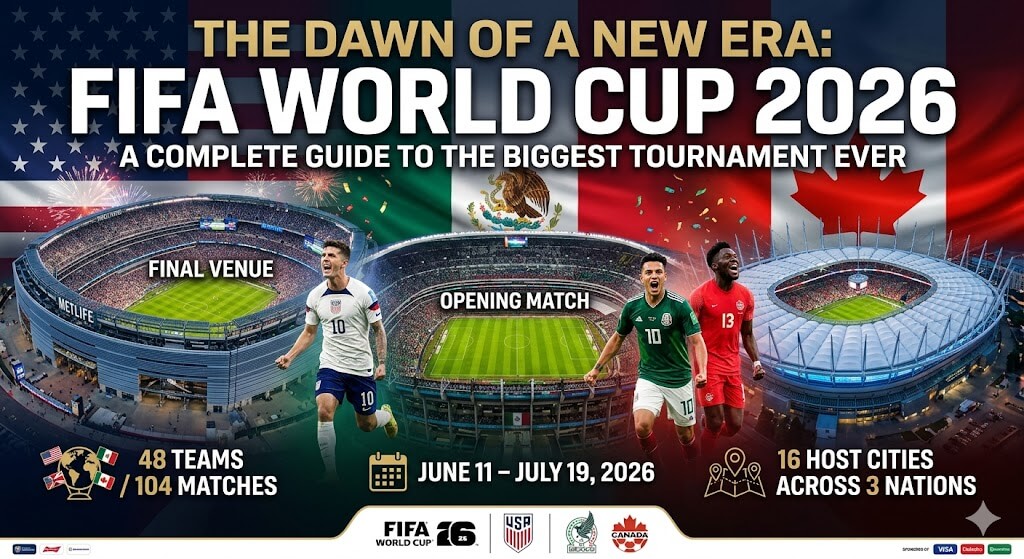
The Dawn of a New Era: A Complete Guide to the FIFA World Cup 2026
The football world is standing on the precipice of history. The FIFA World Cup 2026 is not just another edition of the beautiful game’s ultimate tournament; it is a groundbreaking, record-shattering spectacle. For the first time ever, the tournament will be co-hosted by three nations—the United States, Mexico, and Canada—and will feature an expanded format of 48 teams, making it the biggest World Cup ever organized.
From the historic high-altitude venues of Mexico to the ultra-modern arenas of the United States and the passionate sports cities of Canada, here is your definitive, professional guide to the matches, teams, dates, and stadiums of the 2026 World Cup.
1. A Massive Format Expansion: 48 Teams, 104 Matches
In a historic shift from the traditional 32-team format, FIFA has expanded the tournament to 48 nations. This means more global representation, more dark-horse stories, and a massive total of 104 matches packed into an intense summer of football.
The teams are divided into 12 groups of four. The top two teams from each group, along with the eight best third-placed teams, will advance to a brand-new knockout stage: the Round of 32.
- The Host Nations: USA, Mexico, and Canada all qualify automatically.
- The Global Grid: Giants like Argentina (the defending champions), Brazil, France, England, and Germany will compete alongside a highly competitive lineup of African, Asian, and Arab powerhouses like Egypt, Morocco, Saudi Arabia, and Algeria, all aiming for ultimate glory.
2. Key Dates to Remember
The tournament is scheduled to run from June 11, 2026, to July 19, 2026. Mark your calendars for the most critical milestones of the tournament:
- Opening Match: June 11, 2026 (Featuring Mexico)
- Group Stage: June 11 – June 27, 2026
- Round of 32: June 28 – July 3, 2026
- Round of 16: July 4 – July 7, 2026
- Quarter-Finals: July 9 – July 11, 2026
- Semi-Finals: July 14 – July 15, 2026
- Third-Place Playoff: July 18, 2026
- The Grand Final: July 19, 2026
3. High-Profile Opening Fixtures
The tournament kicks off with staggering momentum. Each host nation will have its own grand opening day celebration accompanied by star-studded opening ceremonies featuring global icons like Shakira and Burna Boy.
The Epic Week 1 Matchups:
| Date (2026) | Fixture | Group | Stadium & Location |
|---|---|---|---|
| Thursday, June 11 | Mexico vs. South Africa | Group A | Mexico City Stadium (Estadio Azteca), Mexico City |
| Friday, June 12 | Canada vs. Bosnia & Herzegovina | Group B | Toronto Stadium (BMO Field), Toronto |
| Friday, June 12 | USA vs. Paraguay | Group D | Los Angeles Stadium (SoFi Stadium), California |
| Saturday, June 13 | Brazil vs. Morocco | Group C | New York New Jersey Stadium (MetLife), East Rutherford |
| Monday, June 15 | Belgium vs. Egypt | Group G | Seattle Stadium (Lumen Field), Washington |
| Monday, June 15 | Saudi Arabia vs. Uruguay | Group H | Miami Stadium (Hard Rock Stadium), Florida |
| Tuesday, June 16 | France vs. Senegal | Group I | New York New Jersey Stadium, East Rutherford |
| Wednesday, June 17 | England vs. Croatia | Group L | Dallas Stadium (AT&T Stadium), Texas |
4. The 16 Iconic Host Cities and Stadiums
The matches will be played across 16 world-class venues divided into three regional zones (Western, Central, and Eastern) to minimize travel weariness for teams.
Mexico (3 Host Cities)
Mexico brings unparalleled football heritage, becoming the first country to host games in three different World Cups (1970, 1986, 2026).
- Mexico City Stadium (Estadio Azteca): The historic crown jewel of North American football. Sitting at 2,200 meters above sea level with a capacity of over 87,000, it will officially host the tournament’s opening match.
- Guadalajara Stadium (Estadio Akron)
- Monterrey Stadium (Estadio BBVA)
Canada (2 Host Cities)
Canada will provide a vibrant, multicultural backdrop for its first-ever men’s World Cup games.
- Toronto Stadium (BMO Field)
- BC Place (Vancouver)
United States (11 Host Cities)
The US dominates the venue list with massive NFL-sized stadiums equipped with cutting-edge technology and premium fan experiences.
- New York New Jersey Stadium (MetLife Stadium) – Host of the Grand Final
- Los Angeles Stadium (SoFi Stadium)
- Dallas Stadium (AT&T Stadium)
- Miami Stadium (Hard Rock Stadium)
- Boston Stadium (Gillette Stadium)
- Atlanta Stadium (Mercedes-Benz Stadium)
- Houston Stadium (NRG Stadium)
- Kansas City Stadium (Arrowhead Stadium)
- Philadelphia Stadium (Lincoln Financial Field)
- San Francisco Bay Area Stadium (Levi’s Stadium)
- Seattle Stadium (Lumen Field)
5. What Makes This World Cup Unique?
Beyond its size, the 2026 World Cup is a cultural festival celebrating diversity across a continent.
A Dynamic Fan Experience: Because the tournament spans multiple time zones—from the Pacific coast of Vancouver and Los Angeles to the Atlantic coast of New York and Boston—fans worldwide will enjoy around-the-clock football coverage.
Tactically, the new 48-team layout eliminates the possibility of final-round collusion in the group stage, as groups consist of 4 teams instead of 3 (as originally proposed), keeping the sporting integrity completely intact. With more teams from Africa, Asia, and the Americas securing well-deserved spots, the tournament truly embodies its global name.
Conclusion
The FIFA World Cup 2026 is set to rewrite the history books. Whether you are rooting for the traditional powerhouses, backing Arab and African nations to repeat Morocco’s legendary 2022 run, or looking forward to seeing how the co-hosts perform on home soil, this tournament promises unforgettable drama. The stage is set, the stadiums are ready, and a continent awaits to welcome the world.
